Accessory 1: SI‑850 Series Configuration Data File (U25274)
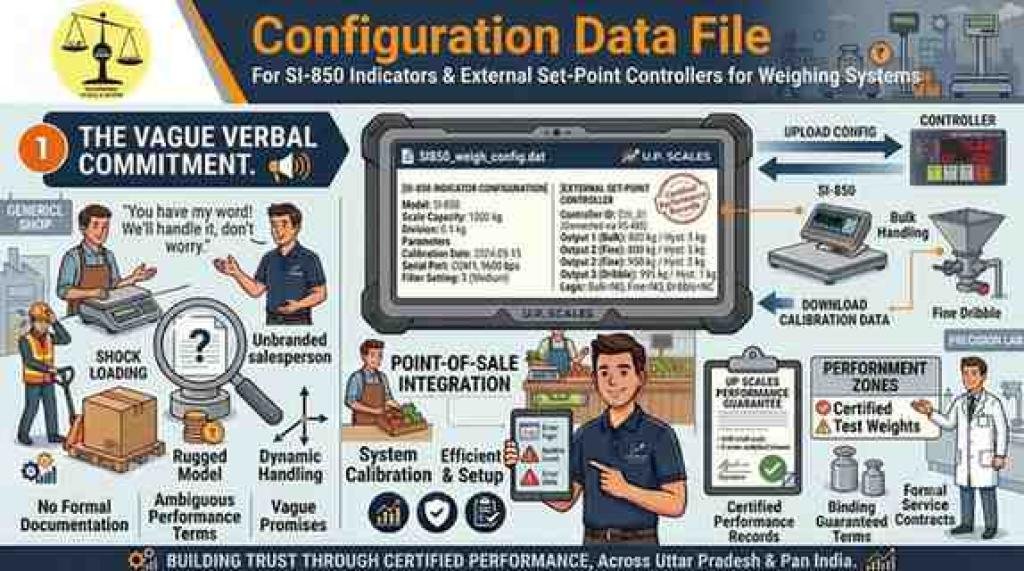
The SI‑850 is a versatile, high‑performance weighing console used across a wide range of industrial applications—from batching and filling to check‑weighing and process control. Like all advanced digital indicators, it relies on a specific set of internal instructions to interpret load cell signals, apply filtering, manage communication ports, and execute custom logic.
The SI‑850 Series Configuration Data File is a digital accessory that serves as the complete operational blueprint for this console. It is an EQDF (Essae Quality Data File) that contains everything from the linearization curve of the connected platform to the baud rate settings for serial communication.
Instead of manually entering hundreds of parameters through the front keypad—a tedious and error‑prone process—this file allows you to instantly load a verified, validated configuration into the SI‑850. This is particularly valuable when deploying multiple consoles across different production lines or when recovering a unit after a mainboard replacement.
Key Benefits:
- Rapid Deployment & Recovery: Uploading this file restores a fully functional configuration in minutes. In the event of a hardware failure or memory corruption, this file is your fastest path back to operational status, minimizing costly production downtime.
- Uniformity Across the Facility: When you have multiple SI‑850 consoles running the same weighing application (e.g., filling identical bags or batching the same recipe), this file ensures that every unit applies the exact same filtering, zero‑tracking, and tolerance settings. This consistency eliminates the variability that can arise from manual configuration differences.
- Seamless Communication Integration: The file pre‑configures the console's communication parameters, ensuring plug‑and‑play compatibility with attached accessories like remote displays, printers, PLCs, or host computers. It eliminates the need for a technician to troubleshoot handshake protocols on the shop floor.
- Optimized Performance: The file includes the specific calibration coefficients and linearization points that compensate for the mechanical characteristics of the load cells and the platform structure. This ensures that the SI‑850 delivers its specified accuracy across the entire weighing range.
Who is this for?
- Production managers deploying multiple SI‑850 consoles across different shifts or locations.
- Maintenance engineers who need a reliable backup to restore systems quickly after servicing.
- System integrators who require a pre‑validated starting point for custom automation projects.
Accessory 2: External Set‑Point Controller (U4931)
While an indicator is excellent at displaying weight, many industrial processes require the system to take action when a specific weight is reached. The External Set‑Point Controller is a physical hardware accessory that turns your weighing indicator into a fully automated control device.
This unit provides discrete output signals—typically relay closures or solid‑state switches—that are triggered when the weight on the scale crosses a pre‑programmed threshold. When the weight equals, exceeds, or falls below the set value, the controller sends a signal to an external device, enabling or disabling the next step in your process.
Key Features & Benefits:
- Automated Process Control: Connect the set‑point output to an alarm, a conveyor belt motor, a solenoid valve, or a packing machine. For example, when a bag reaches the target weight, the set‑point triggers a conveyor stop or an audible "fill complete" alarm, eliminating the need for manual operator intervention.
- Over/Under Check‑Weighing: In quality control applications, the set‑point can be configured to discriminate between acceptable and rejectable weights. You can trigger a red light for under‑weight items and a green light for correct‑weight items, creating an instant visual sorting system.
- Dual or Multi‑Setpoint Capability: Depending on the configuration, this controller can support multiple threshold levels. For instance, a "pre‑set" output can slow down the filling speed as the weight approaches the target, and a "final‑set" output can stop the flow completely at the exact weight, improving both speed and accuracy.
- Reliable & Industrial‑Grade: The set‑point controller is built to operate in harsh environments, with robust relay contacts that can handle the electrical loads of typical industrial actuators. The isolated outputs ensure that electrical noise from the actuator does not feed back into the sensitive weighing electronics.
Compatibility:
The External Set‑Point Controller is designed for use across a range of Essae indicator models, including:
- DX‑415
- DX‑451
- DC‑851N
Note: This is a physical accessory that typically connects via the indicator's expansion port or I/O connector. Always verify that your specific indicator has the required I/O interface to support external set‑points.
Who is this for?
- Filling and packaging lines where precise weight control is essential to meet regulatory requirements and reduce product giveaway.
- Batching plants where multiple ingredients must be added in sequence, each triggering a different output.
- Any process where weight‑based automation replaces manual decisions, leading to higher throughput and lower labour costs.
Combined Applications: The Software + Hardware Synergy
While the Configuration File (U25274) sets the SI‑850's internal behaviour, the External Set‑Point (U4931) provides the physical muscle to act on that behaviour. Together, they transform a simple weighing console into a comprehensive industrial controller.
- The configuration file ensures the indicator reads accurately and filters noise.
- The set‑point controller takes that accurate reading and drives external machinery.
For example, in a bagging operation:
- The SI‑850 is configured (via the EQDF file) for the specific bag weight and tolerance.
- The External Set‑Point is connected to the filling valve and conveyor.
- As the weight approaches the target, a pre‑set output slows the feed.
- At the exact target weight, the final set‑point closes the valve and starts the next bag cycle.
This level of automation reduces product giveaway, speeds up production, and ensures consistent quality—all without requiring the operator to constantly watch the display.
Critical Compatibility & Installation Notes
- Configuration File: The U25274 file must match the exact hardware revision and firmware version of your SI‑850 console. Using an incompatible file can render the indicator unresponsive. It is typically loaded via a USB port or memory card using the console's service menu.
- Set‑Point Controller: Proper wiring and configuration are essential. The output type (relay, NPN, or PNP) must match the input requirements of the external actuator. Always consult the technical manual for pin assignments and electrical ratings.
Original Source: https://upscales.buyweighingmachine.com/blog/configuration-data-file-for-si850-indicators-external-setpoint-controllers-for-weighing-systems